My Move 37 moment
In my previous blog post, describing work I did over the Christmas break 2025, I wrote about my first attempt to engineer a serious application using Claude Code. I had downloaded my personal data from Fitbit, and used the agent to engineer a client-server application to import, host, transform and export that data, and to serve as a display to replace the Fitbit dashboard that Google had taken off the internet. In that project, I took care to make the AI stick to the architecture, watched code quality, and hand reviewed every line before it was committed. In the conclusion of that post, I wrote the following. It will soon become clear why I highlighted one phrase in this quote.
It’s perfectly capable of implementing a design and architecture philosophy when asked to do so, and it is capable of weighing pros and cons of technical choices. This used to be the entire how part of the job, so our work has changed significantly and permanently, there is no way around it. The what and why parts are different, because the choices made there depend on priorities. The agent doesn’t need a Fitbit dashboard. The agent has no reason to care why the total number of steps per day is interesting, but the average number of heartbeats per day is not.
Maybe next year the what and why steps will be automated too, but as of early 2026, Claude Code is not the tool for that yet.
Well here we are almost a year later. Besides Fitbit, I’ve been using a calorie counting app for about a decade. Apart from the embarrassing name, the app is perfectly fine. It has a feature to sync its data with Apple Health, but only going forward, not with historical data. That’s ok, I’ll vibe code it. I have been using T3Code for this, which is an orchestrator of harnesses. In simpler terms, it allows you to control Claude Code, Codex, Cursor, Grok etc. from one single application, which is really useful if you’re on the $20 tier of several of them. When you hit your token limit with Claude, you just seamlessly switch to Codex and continue working without interruption. It also has a few other neat features, such as a mini browser window that the agent can click while testing and developing the application it is building for you.
I downloaded my 10 years of diet data from the website, and gave Claude Opus 5.5 the following prompt:
look in this directory. fatsecret-apple-health-2017-10-12-2026-10-18 contains diet data that should be in the format of apple health. make a plan to create an app to import that data into my apple health
I won’t copy the development plan Claude presented because I believe in sharing the prompt, not the slop. The plan was solid. It would make a simple python web application to import the data, store it in a SQLite database, display the data in a simple web UI, and export it in Apple Health import format. It also created a plan to build an iOS app to import the data on my phone. Apple only allows write access to HealthKit from an iOS device.
Looking at the data, Claude asked some clarifying questions about timestamps, because the diary entries were not all in the same time zone. Here’s my second prompt of the session to answer that question:
ive travelled between continental europe and the US a lot over the years. was mostly based in amsterdam, am now based in north carolina
It replied that this makes sense, there was no problem with the timestamps after all and entries had really been logged from Amsterdam (CET/CEST), North Carolina (ET) and US West Coast (PT).
It next asked me if I had Xcode installed and if I had a developer account. After answering those questions, it built both the web application and the iOS app, imported the data, exported it to Apple Health format XML, and deployed the single-use iOS app on my phone. I had to run it manually and click the button to import the XML file, and it was done. I can now get a bar chart of the average daily amount of Polyunsaturated Fat I consumed in July 2018. Awesome!
At no moment did I ever look at the code, because it wasn’t relevant. The entire application was single-use. No one would ever have written a single-use web application and iOS app by hand before; it would have taken weeks, not counting research.
My Move 37 moment
The vibe coding experience above didn’t shock me. A period of 10 months is not a long time, but it felt like a long time. I’ve made an effort to stay on top of developments in Agentic Engineering and maintain some level of understanding of the underlying theory and limitations of the technology, so this didn’t come as a surprise. I fully expected this to work exactly as I described above.
For my next project, I decided to import the roughly 10 years of records of runs, rides and hikes from the MapMyFitness app into Apple Health as well.
I’ll share the prompt, not the slop:
this project contains csv with workouts from mapmyfitness.com we want to make a local application that does roughly the same as the official website but only for my data
That’s the whole prompt. About an hour later I had the app to import and view the data. A few more prompts to add local storage in SQLite and an export function to Apple Health format, and it was done. It made a nice dashboard with bar charts per activity. I hadn’t told it to do that, it just understood how I would want this data to be displayed.
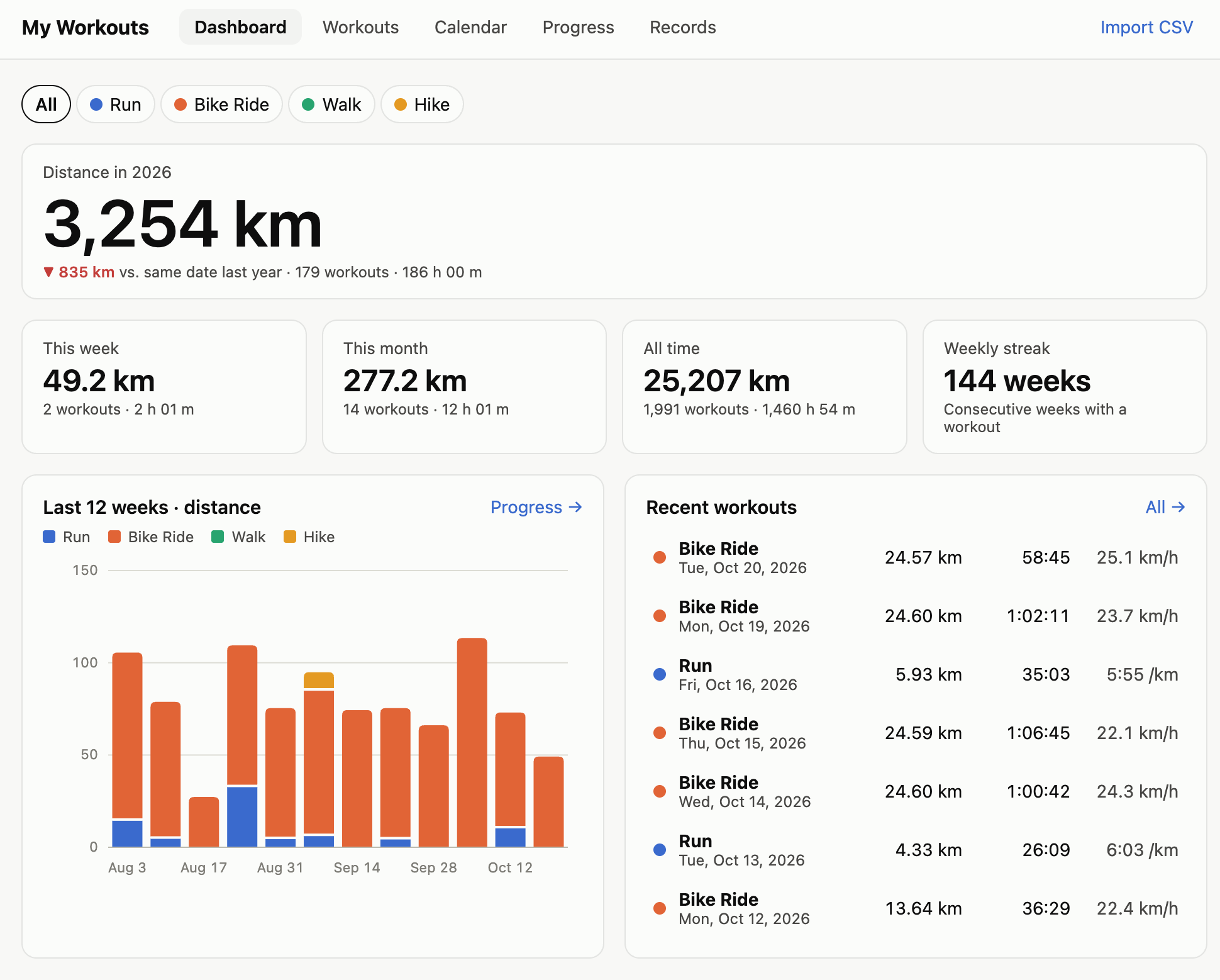
In the chart above, I noticed something weird. I ran 32 km in a week in August? I haven’t been capable of such feats since I injured my knee a couple of years ago. Maybe the bot made a mistake? This was exciting, not because I want the bot to fail; I went through that stage a few years ago and am fully in the acceptance stage now. It was exciting because there was something to investigate. Or so I thought.
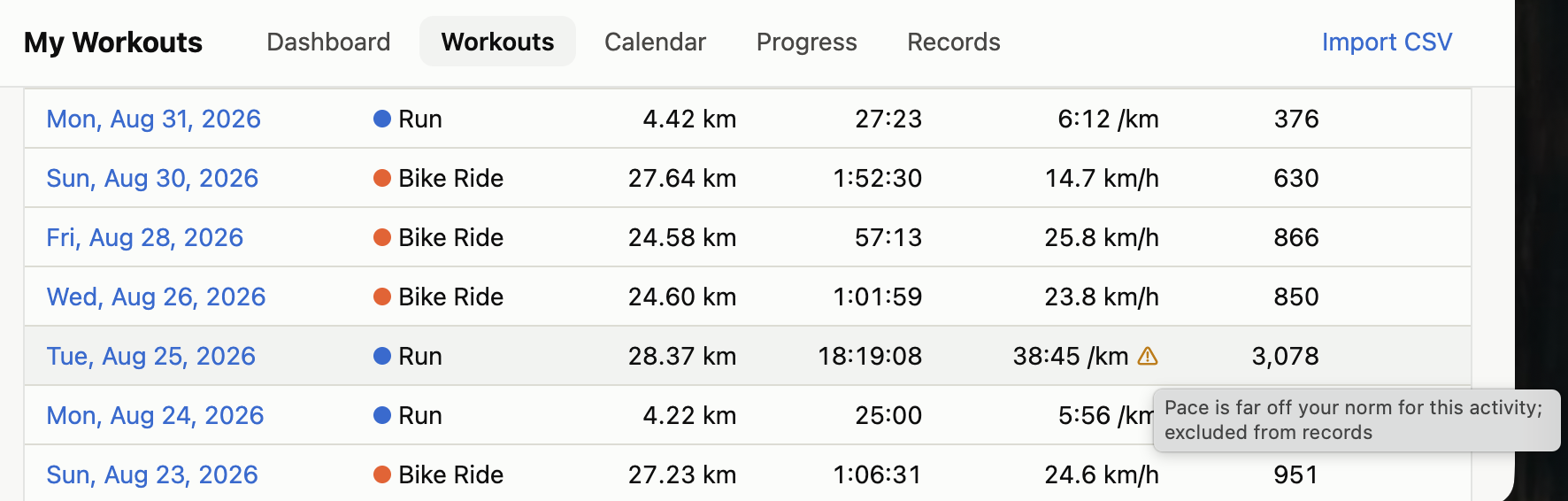
Oh… I clicked through to the detail page. It had made a very nice detail page without being asked.
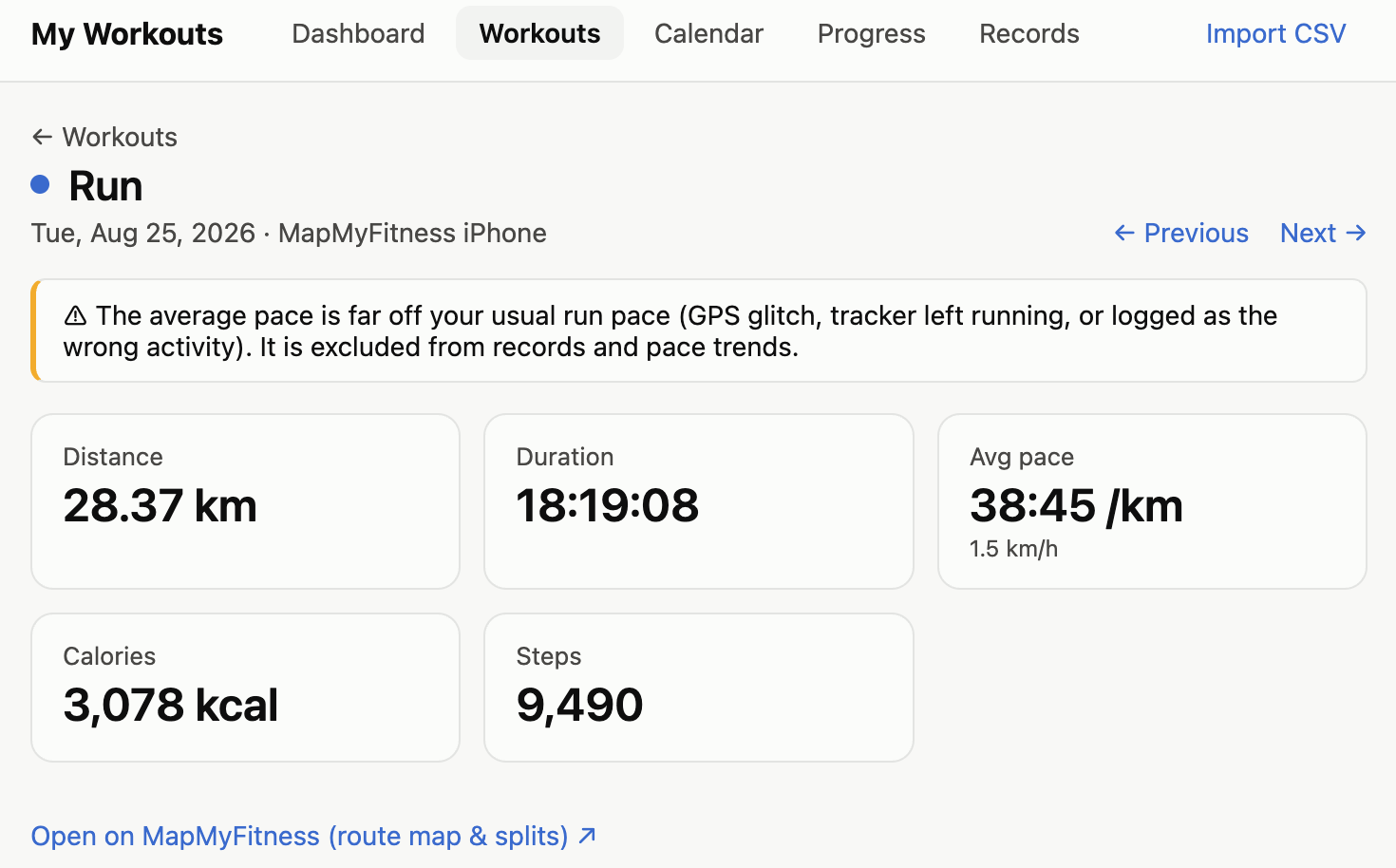
I looked at the CSV, and saw no warning there. I asked the agent:
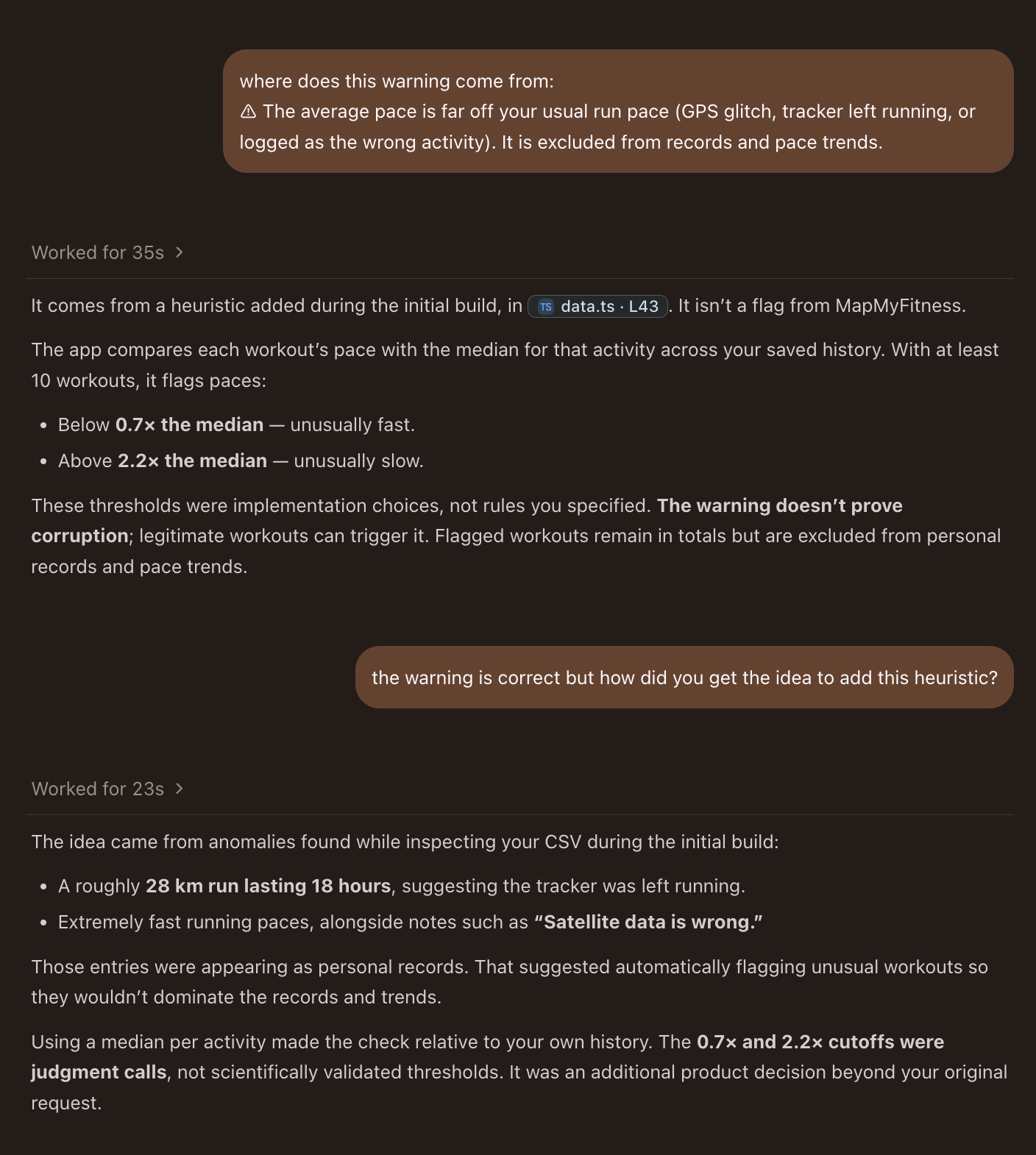
where does this warning come from:
⚠ The average pace is far off your usual run pace (GPS glitch, tracker left running, or logged as the wrong activity). It is excluded from records and pace trends.
I’ll include the screenshot of the full response:
Now in the past, with older, slower phones, the tracker would sometimes fail to keep up. The tracker uses a combination of GPS coordinates and maps of roads and trails to make an accurate estimate of where you are.
It would sometimes lose connection with GPS, especially going on trails far off road, so sometimes instead of tracking me on the running trail, it had me teleporting back and forth between two adjacent roads, so it would show me as having run for example 12 km instead of 10, giving an implausibly high average speed. I’d add that in the comments afterwards. Don’t blame the app for that; the problem never occurred after finally upgrading to a newer phone. I haven’t had to add comments to records in years.
From my comments from several years ago, the agent deduced that the data might not always be 100% reliable, and completely on its own - again, I shared all the relevant prompts here - decided to design an algorithm to detect faulty data and excluded it from the aggregated stats. The offending record on August 25th probably reflects me going on a morning run, then forgetting to turn the tracker off, sitting at my desk working all day, driving to the store and perhaps taking a nap, covering 28.37 km in 18 hours and 19 minutes at an average pace of 38 minutes and 45 seconds per kilometer. That is not the work of a stochastic parrot, or even a junior developer.
In 2016, AlphaGo played against professional Go player Lee Sedol. During this match, it made the now famous ‘Move 37’. This was a surprising and unconventional move played by Google DeepMind’s artificial intelligence, AlphaGo, during the second game of its historic 2016 match against Go world champion Lee Sedol.
Since then, the term ‘Move 37’ has become an expression for situations where an AI shocks and surprises people by exceeding expectations of its capabilities. This was my Move 37 moment. I don’t mean Claude made an alien or inhuman move, quite the opposite. It unexpectedly acted like a human engineer.
A year ago, Claude made a Fitbit dashboard for me where it displayed the day’s average heart rate, because why not? For the bot, heart rate is just a number, right? I wrote:
The agent has no reason to care why the total number of steps per day is interesting, but the average number of heartbeats per day is not.
At the time I thought we had reached the limitations of AI coding agents here. Without lived experience of the world, it would need a human to decide what’s interesting and what isn’t, right? Well here I am, a year later, reconsidering this statement.
Senior Software Engineer
In these exchanges, Claude didn’t act like a bot; it acted like a senior software engineer. It asked clarifying questions, it noticed discrepancies in the data and asked me about those, then it came up with a design and implemented and tested it. It implemented useful features I didn’t explicitly ask for, without also adding useless or irrelevant features.
If you are still dismissing coding agents as fancy autocomplete, a stochastic parrot, or only suitable for dumb routine work, I am not going to debate this topic with you any more.
Last year, leaders of the frontier AI labs predicted that in a year to 18 months, we would be at the point that we are now. I think Google demonstrated that a drawing on a paper napkin was enough of a design for Gemini to build an entire website. When their model was released to the public, it fell short of the expectations. It became tempting to dismiss the grandiose claims as marketing. Well, we are there now.
At the Rails World 2026 Opening Keynote, DHH made the following statement:
It’s pencils down, people. Writing code by hand is no longer an economically viable skill for most programmers at most companies. But the future of making software has never been brighter. Don’t you dare black pill this beautiful moment!
I am ambivalent about his optimism about the future, but I’m not in denial. If I want to do the best I can do, in 2026 that is not writing code by hand. I will adapt, but I’m not yet at DHH’s stage of enthusiasm about the situation.
I wrote my first line of code in the late 1980s. The ability to code, create software, research, troubleshooting and debugging have been part of my identity as well as my source of income throughout my adult life. We have to either admit that this is coming to an end, or keep retreating into ever smaller corners of the profession where bots can’t or aren’t allowed to go yet.
I’ll leave you with this Eulogy for the Software Engineer.